Updated November 2026.
Quick answer:
- Unweighted: light and springy, like an organ or synth.
- Semi-weighted: springs plus a little weight. Common on MIDI keyboards.
- Hammer action: a mechanism with small hammers that imitates a piano’s resistance.
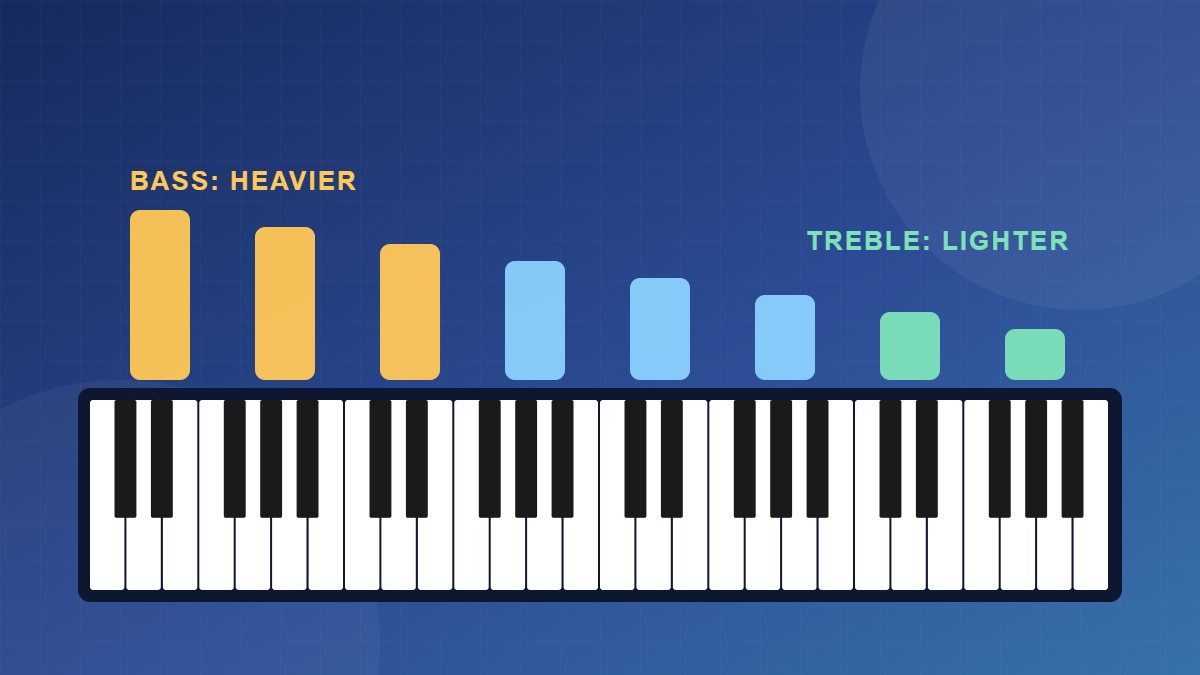
- Graded hammer action: heavier in the bass and lighter in the treble, like a real piano.
To learn piano, choose graded hammer action.
The four types compared
| Type | Feels like | Found on | Good for |
|---|---|---|---|
| Unweighted | Light, springs straight back | Cheap keyboards, synths, organs | Synth parts, organ, fast synth lines |
| Semi-weighted | Some resistance, still springy | MIDI keyboards, stage keyboards | Producing, synths, a mix of sounds |
| Hammer action | Weighty, with a piano-like push | Digital pianos, 88-key controllers | Learning and playing piano |
| Graded hammer action | As above, heavier at the bottom | Most digital pianos | The closest to an acoustic piano |
What the brand names mean
Each maker names its actions, which makes comparing hard. Some current examples:
| Brand | Entry-level action |
|---|---|
| Yamaha | GHC (Graded Hammer Compact) |
| Roland | PHA-4 Standard |
| Kawai | Responsive Hammer Compact (RHC II) |
| Casio | Smart Scaled Hammer Action |
All are graded hammer actions. Each brand’s more expensive models use heavier, longer or wooden keys that feel closer to a grand piano.
Other terms you’ll see
- Escapement: a slight notch you feel when pressing a key slowly, copied from grand pianos. Nice to have.
- Triple sensor: three sensors per key, so fast repeated notes register even when the key hasn’t fully risen.
- Ivory or ebony feel: textured key tops that stop fingers slipping when they’re sweaty.
- Wooden keys: found on higher-end models. Longer, more even keys feel more like an acoustic.
How to test an action in a shop
- Play as softly as you can. A good action lets you play very quiet notes evenly.
- Repeat one note fast. It should keep up without missing notes.
- Play the lowest and highest keys. The bass should feel slightly heavier.
- Bring a piece you know. Your fingers will tell you more than the spec sheet.
FAQ
Are heavier keys always better?
No. The goal is a feel close to a real piano, not maximum weight. Very heavy keys can cause tension.
Can I learn piano on semi-weighted keys?
You can start, but the move to a real piano will feel hard. Switch to hammer action once you’re committed.
Do 88-key MIDI controllers have hammer action?
Some do. Check the spec; many 88-key controllers are semi-weighted.