Updated November 2026. Prices are rough US figures and vary by country, area and year.
Quick answer:
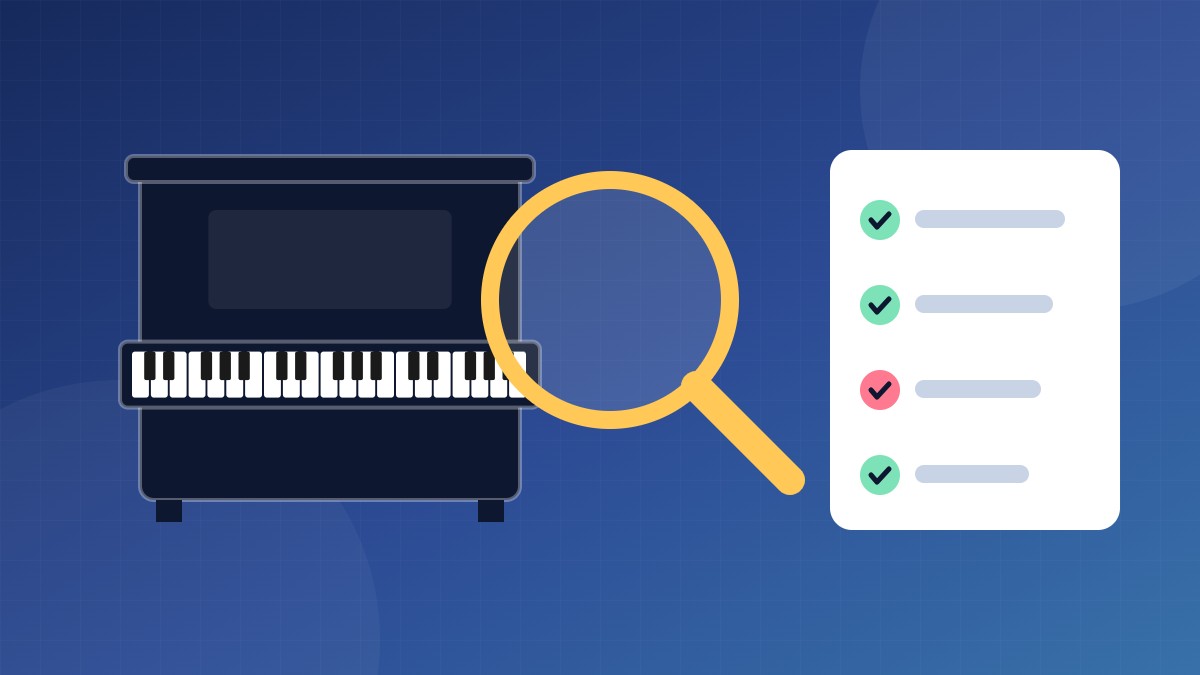
- Ask for the brand, serial number, age and when it was last tuned.
- Play every key, soft and loud, and try all the pedals.
- Look inside at the tuning pins, soundboard, hammers and strings.
- Pay a piano technician to inspect it before you buy. It usually costs about the same as a tuning.
- Budget for moving and a first tuning, possibly a pitch raise.
The checklist
| Check | How | Red flag |
|---|---|---|
| Keys | Play all 88, softly and loudly | Sticking, silent or very uneven keys |
| Pedals | Press each while playing | No effect, squeaks, loose rods |
| Tuning | Play octaves and single notes in the middle | A sour, wavy sound on single notes can mean loose tuning pins |
| Tuning pins | Look along the rows of pins | Pins of mixed sizes or hammered in deep: signs of a worn pin block |
| Soundboard | Look at the large wooden board behind the strings, with a torch | Cracks with buzzing notes nearby |
| Hammers | Look at the felt that hits the strings | Deep grooves or flattened felt |
| Strings | Look along them | Heavy rust, especially in the treble |
| Inside the cabinet | Remove the bottom panel on an upright | Moth-eaten felt, mouse droppings |
The one problem you can’t fix cheaply
The pin block is the wooden block that holds the tuning pins. If it no longer grips them, the piano won’t stay in tune. Replacing it is a major job, often more than $1,000 and sometimes several thousand. It’s hard to judge by eye, which is the main reason to pay a technician before you buy.
Find out how old it is
The serial number is usually on the cast-iron plate, visible when you open the lid. Search the brand and serial number online to find the year. Age alone isn’t a reason to walk away; condition and past care matter more. But the older the piano, the more likely it needs expensive work, unless it has been rebuilt.
Costs people forget
| Cost | Rough guide (US) |
|---|---|
| Professional moving | A few hundred dollars, more for stairs or a grand |
| Tuning | About $100–$225 per visit |
| Pitch raise | Often adds 40–70% to a tuning, for pianos left untuned for years |
| Pin block replacement | Often $1,000 to several thousand |
“Free” pianos: moving, a pitch raise and a few repairs can easily cost more than a well-kept used piano with a known history. Get it checked before you arrange collection.
Private seller, dealer or rebuilt?
- Private seller: the cheapest, with no warranty. Inspect carefully.
- Dealer: costs more, but usually includes checks, delivery, a first tuning and sometimes a warranty.
- Rebuilt or reconditioned: older quality pianos restored with new parts. Ask exactly what was replaced.
Unsure whether you even want an acoustic? Read digital vs acoustic piano first.
FAQ
Should I buy a piano I haven’t played?
No. Every piano feels and sounds different, and problems show up quickly when you play.
Can I check the pin block myself?
You can spot warning signs, such as mismatched pins and notes that won’t hold tune, but a technician can test it properly.
What brands hold value best?
Well-known makers tend to, but a cared-for piano from a lesser-known brand can beat a neglected famous one.